

📑 Table of Contents
- What Is KVA: The Foundation of Servo Stabilizer Calculation
- How Do You Calculate the Right KVA for a Servo Stabilizer?
- Power Factor Reference Table by Equipment Type
- How Do You Complete a Servo Stabilizer KVA Calculation for Different Phases?
- Air Cooled vs Oil Cooled: Which Servo Stabilizer Suits Your Load?
- Servo Stabilizer KVA Sizing: Quick Reference Table for Indian Buyers
- Frequently Asked Questions About Servo Stabilizer KVA Selection
- Conclusion
Selecting the wrong KVA rating is the most common servo stabilizer buying mistake in India. A factory manager who purchases a 10 KVA stabilizer for a 15 KVA load faces constant tripping, equipment damage, and a wasted ₹24,150 investment that cannot do the job.
The good news: the correct KVA size can be calculated in under five minutes with a straightforward formula. This guide covers the calculation method, a power factor reference table by equipment type, three worked examples for common Indian industrial setups, and a ready-reference pricing table mapped to Purevolt India’s full product range.
TL;DR:
– KVA formula: (Total load in kW ÷ Power Factor) × 1.20
– Under 100 KVA: choose air-cooled; above 100 KVA: consider oil-cooled
– Single-phase for light loads up to 15 KVA; three-phase for all heavy industrial equipment
– Always round up to the next standard KVA size; the cost difference is small, the protection is not
What Is KVA: The Foundation of Servo Stabilizer Calculation
KVA (kilovolt-ampere) is the apparent power a stabilizer handles. Choosing the wrong KVA causes either constant tripping or unnecessary overspending.
Most industrial equipment draws more apparent power (KVA) than active power (kW) because of the power factor, which measures how efficiently the load converts electrical power into useful work. A motor rated at 7.5 kW at a power factor of 0.80 actually demands 9.375 KVA from the stabilizer feeding it.
Servo stabilizers are rated in KVA because they must handle the full apparent power of connected loads. An undersized stabilizer overloads immediately: the MCCB trips, output voltage drops, and connected motors draw excess current. Sustained overload damages the stabilizer’s windings and often voids the warranty. An oversized stabilizer, by contrast, costs 2-3 times more than necessary for no functional benefit.
Getting the KVA right protects equipment, keeps costs reasonable, and ensures the stabilizer delivers the output accuracy it promises.
How Do You Calculate the Right KVA for a Servo Stabilizer?
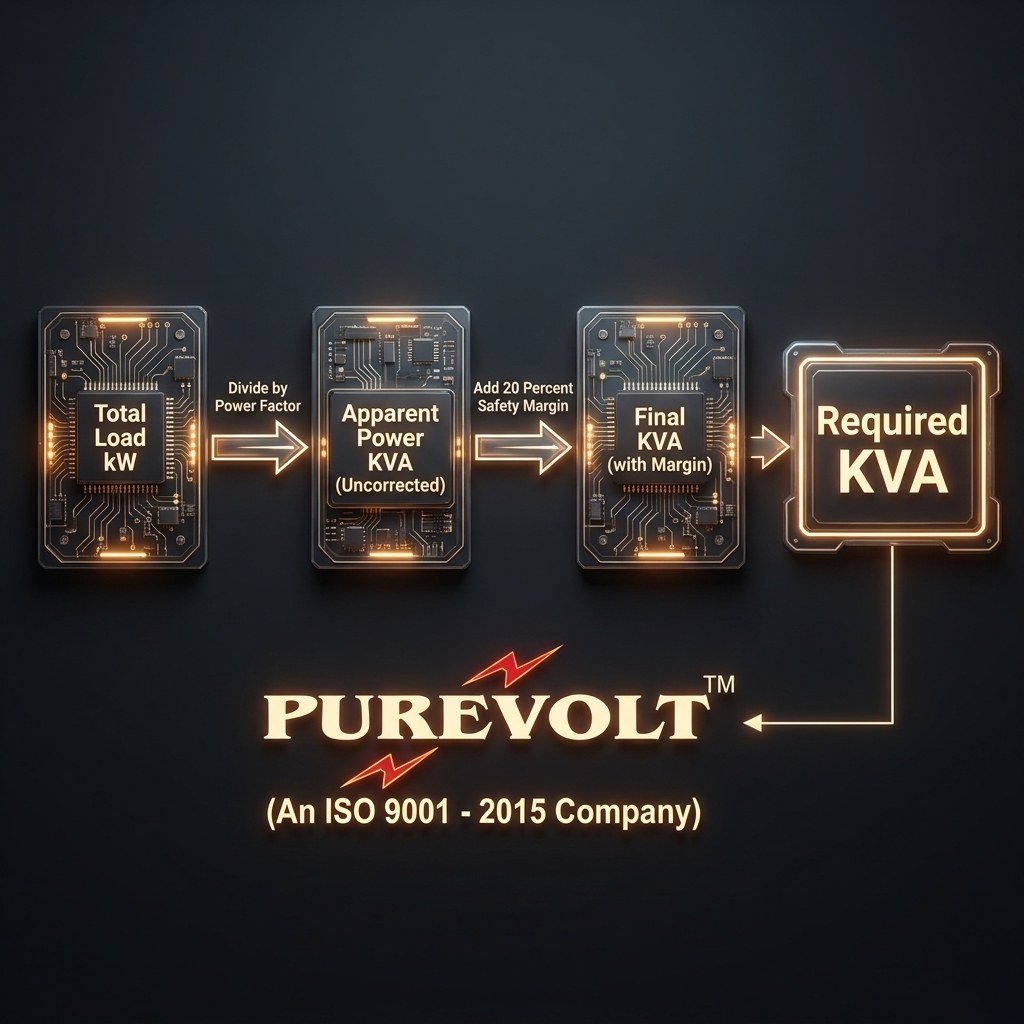
Divide total connected load in kW by the power factor, then add 20% safety margin. The result is the minimum KVA rating required.
The calculation has four steps:
- Add up all connected equipment loads in kW. Check the nameplate on each machine. Most nameplates show kW or HP (1 HP = 0.746 kW).
- Identify the average power factor for the load type. Use the reference table in the next section. Mixed factory loads typically use 0.75-0.80 as a conservative default.
- Divide total kW by the power factor to get apparent power in KVA.
- Add 20% safety margin to account for motor startup inrush current and future load growth.
Formula: KVA = (Total kW ÷ Power Factor) × 1.20
Example 1: Small CNC Workshop
A workshop runs a CNC machine (5 kW), a drill press (2 kW), and general lighting and controls (1 kW), totaling 8 kW. Power factor for motor-dominated loads: 0.80.
KVA = (8 ÷ 0.80) × 1.20 = 12 KVA
The next standard size above 12 KVA is 15 KVA. A 15 KVA single-phase air-cooled servo stabilizer is the correct choice at ₹31,500.
Example 2: Cold Storage Plant
A cold storage facility runs a compressor motor (30 kW), circulation fans (5 kW), and control panels (2 kW), totaling 37 kW. Power factor for refrigeration compressors: 0.82.
KVA = (37 ÷ 0.82) × 1.20 = 54 KVA
A 60 KVA three-phase servo stabilizer covers this load with a comfortable margin.
Example 3: Textile Mill
A textile mill operates looms (200 kW), humidification systems (40 kW), and general services (20 kW), totaling 260 kW. Power factor: 0.78 (older motors, mixed load).
KVA = (260 ÷ 0.78) × 1.20 = 400 KVA
A 400 KVA oil-cooled three-phase servo stabilizer is appropriate. Orders at this scale require a custom quote from the manufacturer.
| Facility Type | Total kW | Power Factor | Base KVA | +20% Margin | Recommended KVA |
|---|---|---|---|---|---|
| CNC Workshop | 8 kW | 0.80 | 10 KVA | 12 KVA | 15 KVA |
| Cold Storage Plant | 37 kW | 0.82 | 45 KVA | 54 KVA | 60 KVA |
| Textile Mill | 260 kW | 0.78 | 333 KVA | 400 KVA | 400 KVA |
Power Factor Reference Table by Equipment Type
Power factor varies by equipment type: motors run 0.70-0.85, resistive heaters at 1.0, and electronic equipment at 0.85-0.95.
Power factor measures how efficiently a device converts apparent power into useful work. A pure resistive load (an electric heater) has a power factor of 1.0; every KVA drawn becomes kW of heat. An induction motor running at partial load can have a power factor as low as 0.70, meaning 30% of the apparent power the stabilizer supplies is reactive and does no useful work.
For mixed factory loads; motors, lighting, electronics, and controls running simultaneously. Use 0.75-0.80 as a conservative default. This is the most common scenario across Indian manufacturing.
| Equipment Type | Typical Power Factor | Notes |
|---|---|---|
| AC Motors and Compressors | 0.70 – 0.85 | Higher for new motors; lower for partial load |
| Industrial Pumps | 0.75 – 0.85 | Centrifugal pumps at full load approach 0.85 |
| CNC Machines | 0.78 – 0.85 | Servo drives have better power factor than older AC machines |
| Resistance Heaters and Ovens | 1.00 | Pure resistive load; power factor always 1.0 |
| Fluorescent and LED Lighting | 0.85 – 0.95 | LED drivers have high power factor; older fluorescent lower |
| Electronic Equipment (computers, servers) | 0.90 – 0.95 | Modern switch-mode power supplies are high power factor |
| Mixed Industrial Load | 0.75 – 0.80 | Use 0.78 as conservative default for factories |
| Welding Machines | 0.60 – 0.70 | Low power factor; size stabilizer generously |
| Cold Storage and Refrigeration | 0.80 – 0.85 | Compressor motors dominate the load profile |
For facilities with welding machines, the power factor can drop below 0.65 during active welding cycles. Size the stabilizer using 0.65 as the power factor, and add a 30-40% safety margin rather than the standard 20%.
The Bureau of Indian Standards IS 9815 defines performance requirements for servo voltage stabilizers manufactured and sold in India, including output accuracy, efficiency, and overload ratings. The Central Electricity Authority of India specifies the national industrial supply standard at 415V three-phase, 50 Hz, which governs all three-phase stabilizer specifications for Indian factory installations.
How Do You Complete a Servo Stabilizer KVA Calculation for Different Phases?
Single-phase stabilizers suit loads up to 15 KVA drawing from one phase. Three-phase is required for industrial motors, heavy machinery, and loads above 15 KVA.
Single-phase stabilizers serve offices, small workshops, medical clinics, retail showrooms, schools, and light commercial establishments. They handle loads up to 15 KVA in most practical applications and are more affordable for non-industrial buyers.
Three-phase stabilizers are mandatory for any facility running induction motors, heavy processing machinery, or combined loads above 15 KVA. India’s industrial grid delivers power at 415V three-phase, 50Hz. Factories, mills, cold storage plants, and pharmaceutical units all operate on three-phase supply and require three-phase stabilizers.
A special configuration worth noting: 3-phase input to 1-phase output stabilizers exist for sites where a three-phase supply feeds predominantly single-phase loads. This is common in commercial buildings with three-phase incoming supply but single-phase equipment distribution.
Purevolt India’s range by phase:
– Single-phase air-cooled: 1 KVA to 200 KVA
– Three-phase air-cooled: 10 KVA to 200 KVA
– Three-phase oil-cooled: 15 KVA to 2500 KVA
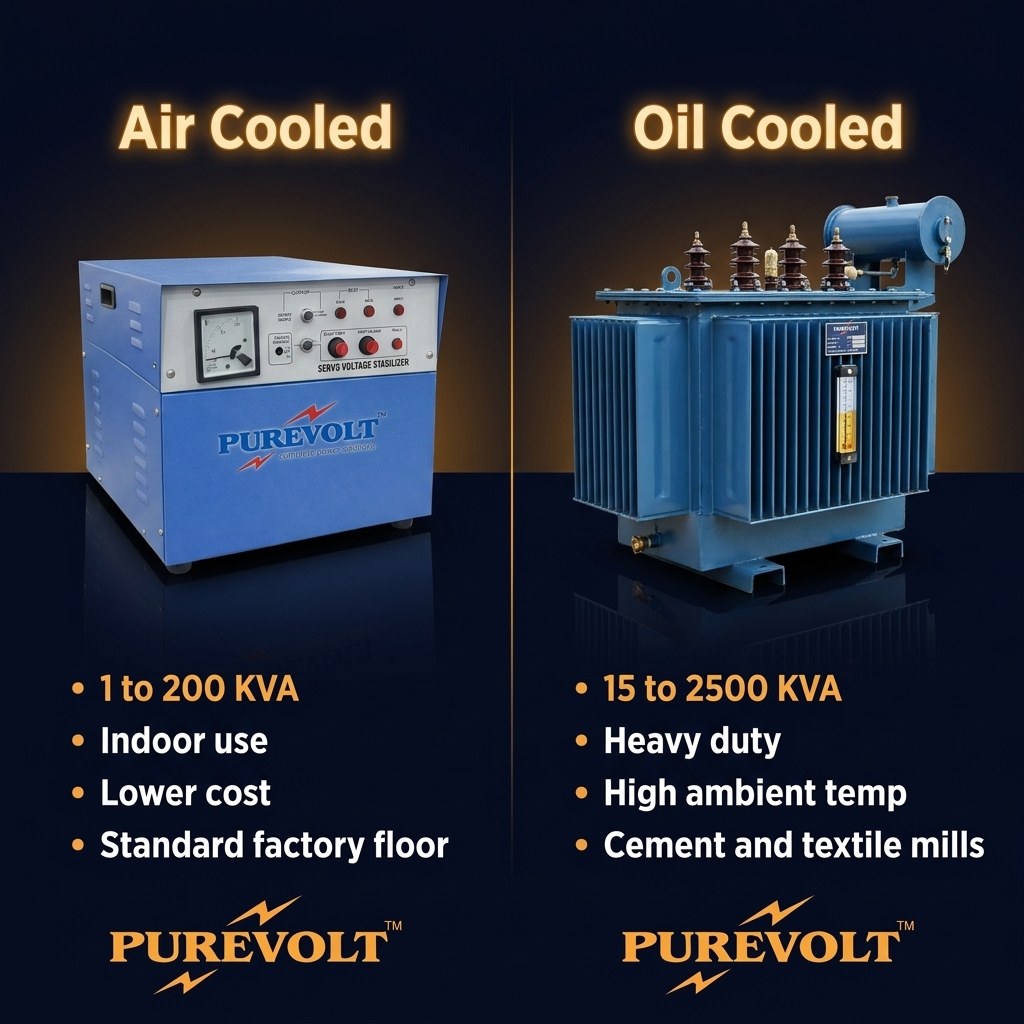
Air Cooled vs Oil Cooled: Which Servo Stabilizer Suits Your Load?
Air-cooled suits loads up to 100 KVA in moderate environments. Oil-cooled is required for loads above 100 KVA, high ambient temperatures, or continuous heavy-duty operation.
Air-cooled servo stabilizers use forced air circulation to dissipate heat. They are lighter, lower cost, easier to install, and well-suited for indoor factory floors, offices, CNC workshops, medical facilities, and cold storage operations up to approximately 100 KVA. The air-cooled range from Purevolt India covers 1 KVA to 200 KVA in single and three-phase configurations.
Oil-cooled servo stabilizers immerse the transformer in dielectric oil for superior heat dissipation. This design handles continuous heavy-duty operation across large industrial plants, including cement factories, textile mills, pharmaceutical units, and oil refineries. The oil-cooled range covers 15 KVA to 2500 KVA and is the standard choice for any load above 100 KVA in challenging environments.
Decision threshold:
– Below 100 KVA, moderate indoor environment: air-cooled
– Above 100 KVA, or any continuous heavy-duty application: evaluate oil-cooled
– Above 200 KVA: oil-cooled is the standard industry choice
– Outdoor or dusty environments (cement plants, quarries): oil-cooled with IP55 enclosure
Oil-cooled units cost approximately 30-40% more than air-cooled for the same KVA rating. The premium is justified by longer operational life and reliability in high-load, high-temperature environments where air-cooled units would require frequent maintenance or replacement.
Servo Stabilizer KVA Sizing: Quick Reference Table for Indian Buyers
Use this table to match your calculated KVA to the correct servo stabilizer type, phase, cooling, and indicative starting price in INR.
Purevolt India manufactures custom configurations to any input/output specification; balanced and unbalanced loads, non-standard voltages for export markets, and site-specific enclosure ratings. Indicative prices below apply to standard configurations. Loads above 60 KVA and all export orders require a direct quote.
Standard units are available for immediate order: the 10 KVA single-phase servo stabilizer at ₹24,150 and the 10 KVA three-phase servo stabilizer at ₹40,635 represent the most commonly specified entry points for light industrial and workshop applications.
| KVA Rating | Phase | Cooling | Typical Application | Starting Price (INR) |
|---|---|---|---|---|
| 5 KVA | Single | Air | Small office, retail, clinic | ~₹15,000 |
| 10 KVA | Single | Air | CNC workshop, printing press | ₹24,150 |
| 15 KVA | Single | Air | Medium office, small cold room | ₹31,500 |
| 10 KVA | Three | Air | Light industrial, packaging line | ₹40,635 |
| 30 KVA | Three | Air | Factory section, food processing | Contact for quote |
| 60 KVA | Three | Air | Cold storage, large factory floor | Contact for quote |
| 100 KVA | Three | Air/Oil | Heavy industrial section | Contact for quote |
| 200 KVA | Three | Oil | Cement section, textile mill | Contact for quote |
| 500 KVA | Three | Oil | Large pharma or textile plant | Contact for quote |
| 1000+ KVA | Three | Oil | Cement, paper, oil refinery | Custom quote required |
For a custom calculation based on actual site load data, request a quote directly from Purevolt India’s engineering team. For general industry applications across factories and plants, see the servo voltage stabilizer for industrial use guide.
Frequently Asked Questions About Servo Stabilizer KVA Selection
Buyers frequently have follow-up questions after calculating KVA. These answers address the most common sizing uncertainties for Indian industrial buyers.
Can I connect multiple machines to one servo stabilizer?
Yes, provided the stabilizer’s KVA rating covers the combined load of all connected machines plus a 20% safety margin.
Calculate the total kW of all machines running simultaneously, apply the correct power factor, add the 20% margin, and choose a stabilizer that covers that total. Never size based on peak nameplate ratings if machines do not all run at full load simultaneously. A facility running five 5 kW motors but only three at any given time can size for 15 kW total rather than 25 kW.
What happens if I undersize my servo stabilizer?
An undersized stabilizer overloads, causing the MCCB to trip repeatedly. Sustained overload causes overheating, winding damage, and complete stabilizer failure.
Connected equipment also suffers during overload events. Output voltage drops below the stabilizer’s rated accuracy, causing induction motors to draw excess current, overheat, and fail prematurely. Most manufacturers void warranties when stabilizers operate above rated capacity. The cost of replacing undersized equipment far exceeds the price difference between two adjacent KVA sizes.
Should I add a safety margin beyond 20%?
A 20% margin handles typical motor startup surges. Add 30-40% if planning significant load expansion within two years, or if the site runs welding machines.
Welding machines have a power factor of 0.60-0.70 and generate high inrush current during arc initiation. They benefit from a 40% buffer above the calculated KVA. Growing factories should also consider projecting their two-year load expansion into the stabilizer specification; the incremental cost of moving from 60 KVA to 75 KVA is far smaller than purchasing a replacement unit in 18 months.
What KVA servo stabilizer does a 10 HP motor need?
A 10 HP motor draws approximately 7.5 kW. At 0.80 power factor with a 20% margin, a minimum of 11.25 KVA is required. Choose a 15 KVA unit for safety.
The conversion is straightforward: 1 HP = 0.746 kW. Multiply motor horsepower by 0.746 to get kW, then apply the full formula. Always round up to the next standard KVA size. For a 10 HP motor, the calculation is: (7.5 ÷ 0.80) × 1.20 = 11.25 KVA, rounded up to 15 KVA.
Is a servo stabilizer the same as an automatic voltage regulator?
A servo stabilizer uses a servo motor to correct voltage continuously. An automatic voltage regulator uses a different correction mechanism. Both regulate voltage but differ in speed, accuracy, and appropriate load size.
Servo stabilizers respond within 20-40 milliseconds and deliver output accuracy of ±1%, making them the preferred choice for precision machinery, medical equipment, and CNC applications. Linear roller-type automatic voltage regulators handle very large loads (100-2500 KVA) with simpler maintenance requirements and are a viable alternative for large plants with relatively stable incoming voltage. For most Indian factory applications below 500 KVA, servo stabilizers are the standard choice.
Conclusion
Selecting the correct servo stabilizer KVA comes down to four decisions: calculate the load using the formula, identify the power factor for the equipment type, choose between single and three-phase based on supply and machinery requirements, and select air-cooled or oil-cooled based on load size and operating environment.
Key takeaways:
– The formula (Total kW ÷ Power Factor) × 1.20 covers 90% of industrial sizing decisions
– Using 1.0 as the power factor for motor loads is the single most common and costly calculation mistake
– Air-cooled stabilizers are right for most indoor factory applications up to 100 KVA
– Always round up to the next standard KVA size; the price difference is marginal, the protection is substantial
For standard KVA sizes with known load requirements, the quick reference table provides immediate guidance. For loads above 60 KVA, custom configurations, or export orders with non-standard voltage specifications, request a quote from Purevolt India’s engineering team with load data for an accurate recommendation.


