

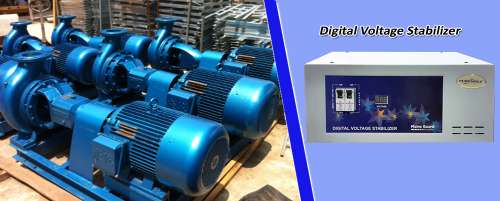
An automatic voltage regulator for an irrigation water pump helps deliver a controlled voltage to the pump motor when the incoming agricultural supply is unstable. Irrigation feeders may experience low voltage during peak demand, high voltage during lightly loaded periods, sudden variations, or phase-related problems. These conditions can increase motor current, cause overheating, reduce starting torque, trigger repeated tripping, and shorten the working life of pumps, contactors, cables, and control equipment.
Purevolt manufactures automatic voltage regulators for irrigation water pumps according to the pump rating, supply phase, measured input-voltage range, required output voltage, installation environment, and protection requirements. The regulator continuously senses incoming voltage and automatically corrects it to provide a stable output within the designed operating range. This makes it suitable for farms, borewells, tube wells, lift-irrigation systems, water-transfer stations, nurseries, greenhouses, and agricultural pumping installations.
Why Irrigation Pumps Need Voltage Regulation
A water-pump motor is designed to operate near its rated voltage. When voltage falls below the acceptable level, the motor may draw more current while producing insufficient torque. It may start slowly, fail to start under load, overheat, or operate inefficiently. Excess voltage can place additional electrical stress on motor insulation and connected controls. In three-phase systems, unequal phase voltages can also create current imbalance and excessive heating.
An automatic pump voltage regulator corrects voltage variations before power reaches the motor. It does not increase the mechanical capacity of the pump or compensate for an incorrectly sized motor, blocked pipeline, poor earthing, or damaged cable. However, when correctly selected and installed, it provides a more suitable electrical supply for dependable pump operation.
How the Automatic Voltage Regulator Works
The control circuit monitors the input and output voltage. When incoming voltage moves above or below the set level, the regulating mechanism adjusts the correction voltage through a variable transformer and buck-boost transformer arrangement. The system continues making corrections as supply conditions change, helping maintain the required output voltage automatically.
Purevolt servo-based voltage-control systems are designed for precise output regulation and can be configured for single-phase or three-phase installations. The correct design depends on the pump motor, connection type, starting method, operating duty, and actual voltage recorded at the site.
Key Features
- Automatic correction of low and high input voltage within the specified range
- Stable output suitable for agricultural pump motors and control panels
- Single-phase and three-phase configurations based on the available supply
- Servo-controlled regulation for accurate voltage correction
- Air-cooled or oil-cooled construction according to rating and duty
- Rugged enclosure suitable for demanding operational environments
- Clear voltage indication and accessible controls
- Custom input range and output-voltage options
- Optional under-voltage, over-voltage, overload, short-circuit, phase-failure, and bypass arrangements
- Designed for continuous irrigation and water-transfer applications
Final features should be selected according to the approved technical specification rather than assumed from pump capacity alone.
Applications
Purevolt automatic voltage regulators can be used with submersible pumps, centrifugal pumps, monoblock pumps, borewell pumps, tube-well motors, agricultural booster pumps, sprinkler-irrigation systems, drip-irrigation pumping stations, farm water-transfer systems, and community irrigation schemes. They may also support pump-control panels, starters, and associated electrical equipment where voltage fluctuations are affecting operation.
Selecting the Correct AVR for a Water Pump
Selection should be based on motor power in HP or kW, rated current, phase, supply voltage, starting current, starting method, measured minimum and maximum input voltage, cable length, duty cycle, ambient conditions, and future load additions. Pump starting current can be substantially higher than running current, so selecting an AVR only from the motor’s normal operating current may lead to undersizing.
Record voltage at different times, especially during peak irrigation hours, and share the motor nameplate details with Purevolt. For a three-phase pump, provide phase-to-phase voltage readings and mention whether imbalance, phase loss, or phase reversal occurs. The engineering team can then recommend the appropriate KVA rating, correction range, cooling method, and protective devices.
Installation and Operating Guidance
Install the regulator in a dry, ventilated location protected from direct rain, flooding, excessive dust, and unauthorized access. Provide correct cable sizing, earthing, upstream protection, and sufficient clearance for cooling and maintenance. The unit should be commissioned by a qualified electrician, and the output voltage, motor current, phase condition, and protective settings should be checked before regular operation.
Automatic Voltage Regulator for Irrigation Pump Price
The price depends on KVA rating, single-phase or three-phase design, input-voltage range, cooling method, enclosure, metering, and optional protections. Share the pump HP, motor nameplate, supply details, measured voltage range, and delivery location for an accurate quotation.
Contact Purevolt to select an automatic voltage regulator for your irrigation water pump that matches the actual electrical conditions at your site.