
Table of Contents
Quick answer
Servo stabilizer power consumption depends on no-load consumption, losses at the loads actually used, energized hours, operating conditions, and the electricity tariff. A full-load efficiency figure describes one operating point; it cannot predict a changing production schedule. Buyers need a whole-unit loss profile and an operating schedule alongside that percentage. Calculate losses during production and energized idle periods separately, then apply the relevant electricity rates to estimate annual cost.
A workshop may run several machines during one shift, fewer during another, and leave its stabilizer energized overnight. When comparing servo voltage stabilizer specifications, assess that complete schedule. Electricity delivered to machinery, stabilizer losses, and maintenance expenditure are separate items.
What Does Servo Stabilizer Power Consumption Mean?
Input real power supplies both the connected equipment and the stabilizer’s own electrical losses. This article calculates the cost of those losses.
The kVA rating describes apparent-power capacity, not continuous electricity consumption. kW measures real power; kWh measures energy accumulated over time.
Power factor is real power divided by apparent power, so kW = kVA × power factor. Current remains central to winding losses: a kW figure alone does not describe the current passing through a unit.
No load means the stabilizer is energized with no useful output load. It remains electrically active; it has not been switched off.
Why Full-Load Efficiency Is Not Enough
1. It describes one operating point.
Full-load efficiency applies under particular test conditions. Without those conditions and part-load data, a catalogue percentage cannot establish an efficiency curve.
2. Production often uses less than rated capacity.
Installed machinery rarely operates simultaneously at maximum demand throughout every shift. Actual loading can differ substantially from the capacity purchased.
3. Idle consumption continues.
Energized magnetic components and controls can consume power after production stops. Longer idle hours increase the annual contribution of this consumption.
Compare daily energized hours with production hours. The gap can be substantial where a plant’s main supply stays on between shifts.
4. Operating conditions change losses.
Input voltage, correction position, temperature, cooling operation, and load characteristics can affect losses. Compare units under equivalent conditions.
For the same useful output, changed input voltage can alter internal currents and correction requirements. A nominal-voltage result cannot represent every supply condition.
5. Annual rankings can reverse.
A unit with better full-load efficiency can cost more over a lightly loaded schedule. Lower loading may reduce absolute losses while increasing their proportion relative to useful output. Efficiency does not necessarily rise continuously with loading.
What Causes No-Load and Load-Dependent Losses?
| Loss source | When it occurs | Information buyers should request |
| Magnetic/core losses | While magnetic components are energized | Watts at stated voltage, frequency, and correction condition |
| Control electronics | During energized operation | Consumption and inclusion in whole-unit figures |
| Winding and contact losses | When current flows | Losses at defined currents and temperatures |
| Servo-motor operation | During voltage adjustment | Correction activity represented in the test |
| Fans or pumps, where fitted | While operating, potentially cycling | Auxiliary ratings, operating schedule, and inclusion |
Schneider Electric’s definition of transformer no-load loss concerns active power under specified voltage and frequency. It explains a component principle, not total servo stabilizer no-load losses.
Measure whole-unit no-load real power in watts. Magnetizing current or VA alone cannot establish billable kWh. Core losses are approximately fixed only for specified voltage, frequency, and magnetic operating conditions.
Servo motors generally operate when adjustment is required; do not assume continuous nameplate consumption. Cooling auxiliaries may cycle, and oil cooling does not automatically imply powered pumps.
Whole-unit readings may already include controls and some auxiliaries. Establish the measurement boundary before adding separate allowances, avoiding double counting.
How to Calculate Servo Stabilizer Running Cost
Use real-power measurements and consistent units:
Efficiency = output real power ÷ input real power × 100
Stabilizer loss (kW) = input real power (kW) − output real power (kW)
Energy lost (kWh) = Σ [loss in each operating period (kW) × hours in that period]
Energy cost (₹) = Σ [energy lost in each tariff period (kWh) × applicable rate (₹/kWh)]
Here, Σ means adding the separate periods. Convert watts to kilowatts by dividing by 1,000.
If efficiency is known at a particular operating point:
Loss = output real power × (1/η − 1)
Express η as a decimal: 98% becomes 0.98. Do not apply that efficiency at other loads without evidence.
For illustration, use this simplified model:
Loss (W) ≈ P₀ + Pᵥ,FL × x²
- P₀: assumed fixed whole-unit consumption in watts.
- Pᵥ,FL: full-load current-dependent loss component in watts.
- x: load current divided by rated current.
Pᵥ,FL excludes P₀. Substituting total full-load loss would count fixed consumption twice.
Schneider Electric describes the fixed-plus-squared-load relationship for transformer losses. Extending that principle to the hypothetical whole-unit model here is an illustrative assumption. It assumes fixed voltage, frequency, temperature, and auxiliary behavior; procurement should use measured whole-unit losses.
Calculate each operating period separately. Squaring one average loading percentage can understate current-dependent losses because the average of squared currents differs from the square of their average.
In the example below, average current loading is 25%, but using that single value misses the higher current-dependent losses during the eight hours at 50%.
If reporting annual efficiency, divide total output energy by total input energy; do not average the individual efficiency percentages.
Use actual time-of-day energy rates where applicable. kVAh billing, demand charges, and taxes require separate treatment beyond this simple ₹/kWh calculation.
Worked Example—A Better Full-Load Figure Can Still Mean Higher Annual Cost
Every input below is hypothetical. Neither unit represents Purevolt or another manufacturer.
Assume two equally rated 50 kVA units operating at rated output voltage with a constant load power factor of 0.8. Full-load output real power is therefore 40 kW.
| Hypothetical parameter | Unit A | Unit B |
| Fixed whole-unit consumption, P₀ | 200 W | 80 W |
| Full-load current-dependent loss, Pᵥ,FL | 600 W | 800 W |
The hypothetical schedule for both units is:
- 8 hours/day at 25% rated current.
- 8 hours/day at 50% rated current.
- 8 hours/day energized with no output load.
- 25 operating days/month; 300 operating days/year.
- Fully de-energized on all other days.
- Illustrative energy rate: ₹9/kWh.
- No additional auxiliary losses beyond the model.
At 25% current, A loses 200 + 600 × 0.25² = 237.5 W; B loses 80 + 800 × 0.25² = 130 W.
At 50%, losses become 350 W and 280 W, respectively. At no load, they are 200 W and 80 W.
Daily loss energy is:
- A: (237.5 + 350 + 200) × 8 ÷ 1,000 = 6.30 kWh.
- B: (130 + 280 + 80) × 8 ÷ 1,000 = 3.92 kWh.
At full load, A’s efficiency is 40 ÷ (40 + 0.80) × 100; B’s is 40 ÷ (40 + 0.88) × 100.
| Calculated result | Unit A | Unit B |
| Full-load efficiency | 98.04% | 97.85% |
| Daily loss energy | 6.30 kWh | 3.92 kWh |
| Monthly energy cost | ₹1,417.50 | ₹882.00 |
| Annual loss energy | 1,890 kWh | 1,176 kWh |
| Annual energy cost | ₹17,010 | ₹10,584 |
Monthly cost equals daily loss energy × 25 × ₹9; annual cost uses 300 days.
B costs ₹6,426 less annually under this schedule because its lower fixed consumption outweighs its higher current-dependent loss component. Another schedule could favor A. Machinery’s own energy consumption is excluded from every loss-cost total.
What Should Buyers Ask for Before Comparing Quotations?
Request:
- Whole-unit no-load input power in watts.
- Losses or efficiency at 25%, 50%, 75%, and 100% load, defining loading and power factor.
- Test input/output voltage, frequency, correction condition, temperature, and cooling status.
- Performance across the proposed input-voltage range.
- Confirmation of included controls, cooling auxiliaries, and motor activity.
- Identification of typical figures versus guaranteed limits.
- Model-specific test reports and measurement accuracy.
- A calculation using your load profile, energized hours, idle hours, and tariff.
Specify whether percentage loading means rated current or real power. Also match phase configuration, voltage range, and output duty; equal kVA labels alone do not establish an equivalent comparison.
Arrange representative logging with a suitable real-power/energy analyzer by qualified personnel. Loss is a small difference between two larger measurements, so instrument uncertainty and synchronized input/output readings matter. Yokogawa’s efficiency measurement guidance explains the importance of synchronizing measurements.
Cover production, changeovers, and idle periods. A brief reading may miss correction activity or cycling auxiliaries. For three-phase units, assess total real power across all phases.
Practical Ways to Manage Running Cost
- Size for the application. Account for operating load, starting current, voltage range, and planned expansion. Avoid universal sizing margins or assumptions that larger units always consume more.
- Review idle hours. Arrange an approved shutdown of genuinely unused supplies while maintaining supplies needed for essential equipment.
- Maintain the installation. Follow manufacturer maintenance instructions, preserve ventilation clearances, and investigate overheating or deteriorating contacts.
- Compare complete ownership costs. Assess annual loss cost alongside purchase price and service requirements. Keep maintenance expenditure separate from electrical loss calculations.
FAQs
1. Does a servo stabilizer consume electricity when no equipment is running?
Yes, while energized. Magnetic components, controls, and any operating auxiliaries can consume power even with no useful output load.
2. Does 98% efficiency mean a fixed 2% loss at every load?
No. It describes the stated operating point. At that point, losses are 2% of input real power; other loads need separate data.
3. How do I calculate the monthly servo stabilizer running cost?
Multiply loss in kW by hours in each operating period, add the resulting kWh, then apply the relevant tariff. Include energized idle hours.
4. Does a higher kVA rating always mean higher power consumption?
No. Capacity alone cannot establish consumption. Compare model-specific fixed and load-dependent losses at the same useful output and operating conditions.
5. Are oil-cooled stabilizers always cheaper to run than air-cooled units?
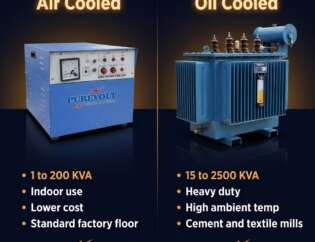
No. Cooling type alone cannot determine running cost. Compare measured whole-unit losses, including any auxiliaries, under equivalent duties and conditions.
6. Can a servo stabilizer reduce my total electricity bill?
It adds its own losses. Any machinery-energy benefit from corrected voltage is load-specific and needs measurement. Do not assume automatic savings, power-factor correction, lower demand charges, or fixed payback.
Conclusion
Compare measured stabilizer losses against the actual operating schedule. Full-load efficiency is one useful figure within that assessment.
Share your load details, voltage range, operating hours, and site conditions to discuss a suitable specification and quotation with Purevolt.