
Table of Contents
Quick Answer: Why Are Isolation Transformers Used in Medical Equipment?
A medical isolation transformer provides galvanic separation: power passes between electrically separate windings without a direct conductive connection. In a suitable design, this helps manage leakage-current pathways and supports electrical safety. In a medical IT installation, it works with monitoring and protection to support supply continuity during a first insulation fault. However, a transformer alone does not make medical equipment or a hospital installation compliant.
- Separates the connected supply from the incoming mains.
- Helps control certain leakage pathways, depending on construction.
- Supports monitored medical IT circuits where required.
- Does not replace earthing, equipment assessment, or backup power.
| Safety consideration | Role of the transformer | What must also be verified |
| Main separation | Separates primary and secondary circuits | Insulation construction and test evidence |
| Leakage-current pathways | Changes some conductive and capacitive paths | Complete equipment and system measurements |
| Supply continuity | Supports an isolated medical IT supply | Monitoring, alarms, and fault protection |
| Application suitability | Provides specified electrical characteristics | Intended use, rating, and documentation |
How a Medical Isolation Transformer Supports Equipment Safety
1. Provides Galvanic Separation from the Mains
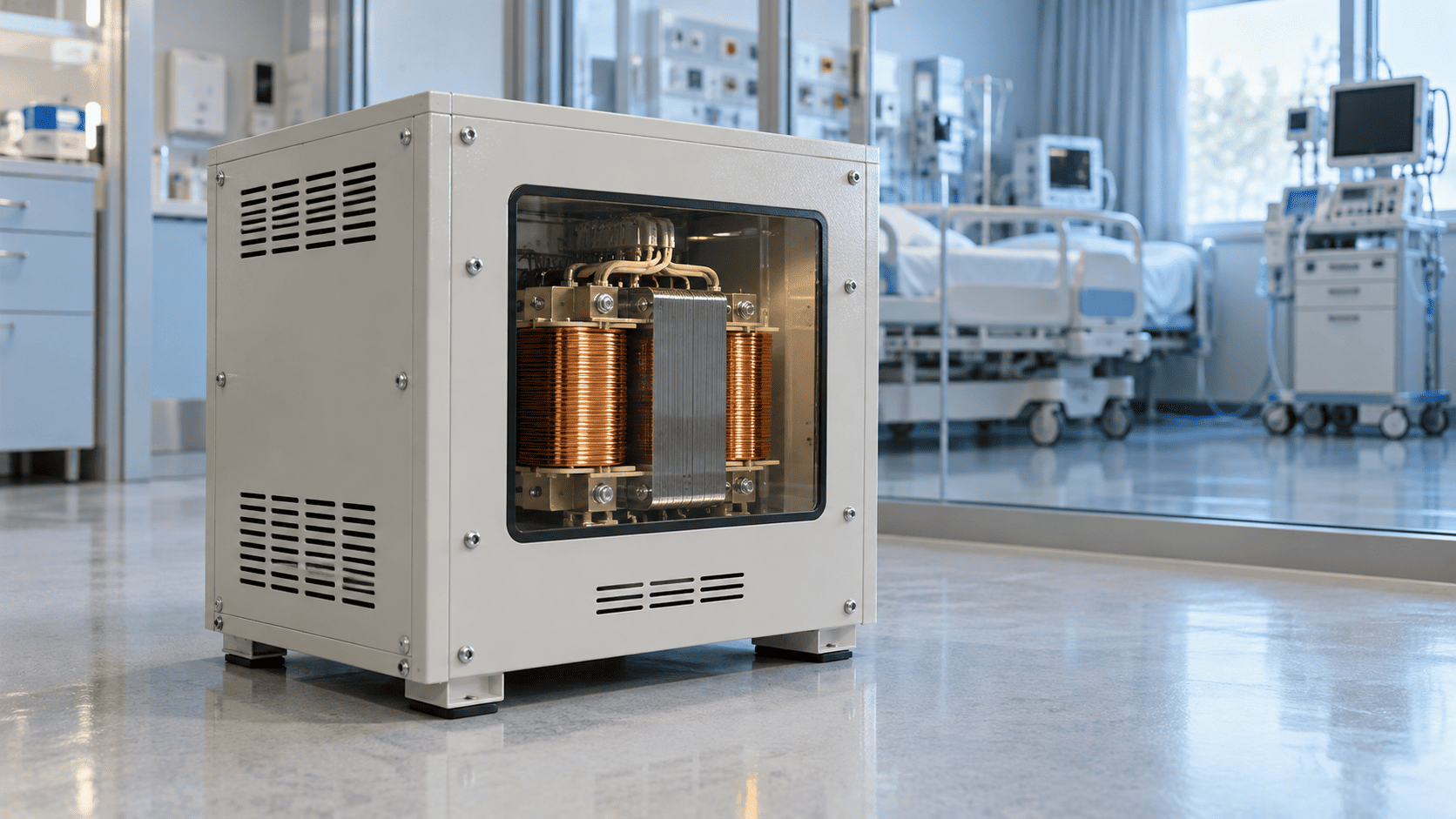
An isolation transformer has physically separate primary and secondary windings. Magnetic coupling transfers energy between them, while insulation prevents a direct conductive connection.
This separation is useful, but hazardous voltage remains available at the output. Contact across secondary conductors can still cause injury, and downstream faults still require appropriate protection.
2. Helps Manage Leakage-Current Pathways
Leakage current is unintended current flowing through insulation, capacitance, or other paths. Protective-earth leakage, touch current, and patient leakage describe different measurement paths.
Although windings are separated, capacitance between them can still pass alternating current. Managing leakage current in a medical transformer therefore requires appropriate construction and assessment of the complete connected system.
3. Supports Patient Protection within a Complete Equipment Design
Medical equipment may require means of patient protection: insulation and other safeguards appropriate to patient contact.
A transformer can contribute to that protection, but its suitability depends on the equipment architecture. Patient-connected circuits, accessible parts, external connections, and fault conditions must also be assessed. Adding an external transformer does not automatically establish compliance.
4. Supports Continuity in a Medical IT System
Here, “IT” describes an electrical supply isolated from earth, rather than information technology. An appropriately designed medical IT system can support continued operation during a first insulation fault while signalling the problem.
Insulation monitoring and accessible alarms are essential parts of this arrangement. Other faults can still require disconnection, so continuity is conditional.
5. Can Help with Certain Electrical Interference Problems
Depending on construction, electrical separation and an electrostatic screen can help reduce certain interference paths. Performance depends on screening, connections, frequency, and the installation.
Isolation is different from voltage regulation, surge protection, and battery backup. A transformer should not be purchased as a universal solution for unstable voltage or every equipment-interference problem.
6. Requires More than a Medical-Grade Label
“Medical grade” should describe verified suitability for an intended application, rather than serve as a general marketing claim.
When reviewing an isolation transformer specification, check the exact model, applicable standard, test evidence, and installation conditions. A general-purpose transformer’s catalogue description does not establish suitability for patient-connected equipment or a medical IT circuit.
7. Must Match the Connected Equipment and Load
Selection should account for input and output voltage, frequency, phase, VA/kVA rating, starting current, and load characteristics.
Heat dissipation, ventilation, and manufacturer instructions also matter. There is no universal sizing margin suitable for every application. Equally, every appliance used inside a hospital does not automatically require an external isolation transformer.
8. Works with Earthing, Bonding, Monitoring, and Protection
An isolated supply does not remove the need for protective earthing of exposed conductive parts where required.
Equipotential bonding helps control potential differences between relevant conductive parts. Monitoring, overload arrangements, thermal protection, and commissioning must match the design. These measures work together; selecting a transformer without reviewing the surrounding installation leaves important safety questions unanswered.
Which Standards and Compliance Requirements Apply?
The main distinction is between equipment safety, transformer suitability, and installation safety. These involve separate assessments.
IEC 60601-1 addresses basic safety and essential performance of medical electrical equipment. Applicable collateral and particular standards supplement or modify its requirements. Request equipment-level compliance evidence and check which standards and editions the assessment covers.
IEC 61558-2-15 addresses isolating transformers for medical IT systems supplying medical locations. It is relevant to that transformer application; it is not a blanket certification route for every transformer used near medical equipment. Request model-specific evidence identifying the assessed construction and applicable requirements.
IEC 60364-7-710 addresses electrical installations in medical locations. Its scope differs from medical equipment assessment. The electrical consultant should establish the location classification, required supply arrangement, protective measures, and verification documentation.
For Indian projects, consult the Bureau of Indian Standards for relevant Indian standards, adoptions, and current status. The project team should separately establish applicable local electrical requirements, regulatory obligations, and tender conditions.
An international standard should not automatically be described as an Indian legal requirement. Likewise, an ISO management-system certificate does not demonstrate medical product compliance.
Safe Installation and Procurement Checks
Before purchasing an isolation transformer for hospital equipment, ask the supplier and project consultant to confirm:
- Nameplate details: model, serial identification, voltage, frequency, phase, and rated capacity.
- Intended application: equipment-level use or a transformer supplying a medical IT installation.
- Test evidence: model-specific reports, relevant test conditions, and the assessed configuration.
- Certification scope: applicable standards, editions, issuing organization, and covered models.
- Load schedule: connected equipment, simultaneous operation, starting demands, and planned additions.
- Installation instructions: environmental conditions, mounting, ventilation, access, and connection requirements.
- Protection and monitoring: arrangements appropriate to the circuit and clinical application.
- Commissioning records: inspection results, safety tests, alarm verification, and handover documentation.
Evaluate these details before comparing quotations. Matching kVA ratings alone does not establish equivalent suitability.
When Should You Consult a Biomedical or Electrical Specialist?
Seek specialist review when:
- Equipment has patient-connected parts or forms part of an interconnected medical system.
- Additional equipment will join an existing medical IT circuit.
- Insulation, load, or temperature alarms persist.
- Overheating, unusual noise, or repeated protective trips occur.
- Connected loads or clinical activities change.
- Equipment fails an electrical safety test.
- Certification or installation documentation is incomplete.
Biomedical engineers assess equipment and patient-related risks; electrical specialists assess the supply and installation. Some changes require both.
Clinical continuity should be managed through the facility’s approved procedures. Staff should not improvise wiring changes, disconnect protective earth, or bypass protection to keep equipment operating.
Medical Isolation Transformer Selection Flow
- Identify the application. List equipment, patient connections, clinical location, and continuity needs.
- Establish the requirements. Confirm equipment standards, location classification, Indian requirements, and procurement conditions.
- Assess the load. Document normal demand, starting current, supply characteristics, and installation conditions.
- Verify the transformer. Compare the exact model and supporting documents against the specification.
- Arrange installation and commissioning. Use qualified personnel and verify protection, monitoring, and equipment compatibility.
- Retain the records. Keep approved drawings, reports, instructions, and maintenance responsibilities together.
This sequence helps prevent a catalogue label from becoming the sole basis for selection.
How to Maintain Electrical Safety after Installation
Maintenance should follow manufacturer instructions and the facility’s maintenance program. Set intervals according to application, operating conditions, and applicable requirements.
- Inspect the enclosure, labels, accessible cables, and ventilation paths.
- Keep cooling clearances free from stored materials and accumulated dust.
- Arrange professional electrical safety testing appropriate to the equipment and system.
- Verify insulation monitoring and alarm functions where fitted.
- Investigate recurring load or temperature alarms.
- Reassess suitability after equipment additions, repairs, or relocation.
- Record tests, faults, corrective work, and changes to the load schedule.
A useful maintenance record identifies what was tested, the configuration, the results, and any unresolved action. An alarm should lead to investigation, rather than repeated acknowledgement without correction.
FAQs
1. What is a medical-grade isolation transformer?
It is a transformer with documented suitability for a specified medical application. Buyers should verify its intended use, insulation design, applicable standards, and model-specific evidence. The label alone does not prove equipment or installation compliance.
2. Is an isolation transformer required for every hospital device?
No. Requirements depend on the equipment design, patient connections, clinical location, and electrical installation. Many devices incorporate their own protection. A specialist should determine whether an external transformer is necessary and compatible with the intended application.
3. How does an isolation transformer affect leakage current?
It changes certain current pathways by separating the primary and secondary circuits. Capacitive coupling and equipment connections can still permit leakage. Its effect must be assessed through appropriate measurements, rather than assumed for every leakage category.
4. Which standards apply to an isolation transformer for hospital equipment?
IEC 60601-1 concerns medical electrical equipment, IEC 61558-2-15 concerns transformers for medical IT supplies, and IEC 60364-7-710 concerns medical-location installations. Applicability depends on the intended use, alongside relevant Indian requirements.
5. Can a servo stabilizer or UPS replace a medical isolation transformer?
Not automatically. A servo stabilizer for medical equipment regulates voltage, while a UPS provides specified power conditioning and backup functions. Neither establishes the required isolation unless its verified design includes suitable isolation for that application.
6. What documents should a hospital request before purchase?
Request the exact model specification, intended-use statement, relevant test reports, certification scope, installation instructions, and maintenance guidance. For a medical IT installation, also obtain the approved system design, monitoring requirements, and commissioning acceptance criteria.
Conclusion
A medical isolation transformer supports electrical safety when its design, rating, and installation match the intended application. Effective selection requires verified documents, appropriate protection and monitoring, and assessment of the complete equipment or supply system. Hospitals should make procurement decisions with biomedical and electrical specialists, then maintain clear commissioning and service records. To discuss a suitable specification, share your equipment and load requirements with Purevolt.