
📑 Table of Contents
- Why You Need an Isolation Transformer for Laboratory Instruments
- Which Laboratory Instruments Benefit Most from Isolation Transformers?
- How Does an Isolation Transformer Protect Laboratory Instruments?
- How to Size an Isolation Transformer for Laboratory Instruments?
- Isolation Transformer vs Servo Stabilizer: What Does a Laboratory Need?
- Frequently Asked Questions About Isolation Transformers for Laboratories
- Conclusion
An HPLC pump motor running in the same panel as a centrifuge induces common-mode noise that corrupts the HPLC detector signal. In a pharmaceutical QC laboratory, that noise causes peak area variability that looks like method error — until an isolation transformer removes the noise source and the problem disappears. Studies show isolation transformers reduce measurement noise by up to 80% in high-sensitivity instruments.
Voltage fluctuations damage laboratory instruments, but electrical noise is the more insidious threat. It does not trip equipment visibly. It introduces measurement error that passes through QC undetected, erodes instrument calibration, and generates false readings that affect product release decisions in regulated laboratories.
This guide explains why laboratory instruments need isolation transformers, which instruments benefit most, how to size a unit for a lab bench, and how isolation transformers differ from servo stabilizers in the laboratory power protection stack.
Why You Need an Isolation Transformer for Laboratory Instruments
Laboratory instruments need isolation transformers to eliminate ground loops and common-mode electrical noise that cause measurement errors, signal corruption, and instrument calibration drift in analytical equipment.
Indian laboratory power supplies — including those in pharmaceutical QC labs, research institutions, and hospital diagnostic laboratories — carry harmonic noise and ground-loop interference generated by nearby industrial equipment, variable-speed drives, HVAC systems, and other instruments sharing the same ground reference. This noise couples into sensitive instrument measurement circuits through the power supply, the ground connection, or both.
IEC 61010-1 safety requirements for laboratory electrical equipment specify isolation as a standard protection measure, and most laboratory instrument manufacturers specify use of an isolation transformer or line conditioner as a prerequisite for instrument performance specification compliance. Operating an instrument without isolation on a noisy power supply does not void the warranty — but it does mean the manufacturer’s accuracy specification may not apply.
For pharmaceutical laboratories operating under FDA 21 CFR Part 211 or CDSCO Schedule M GMP requirements, data integrity rules mean measurement results must be traceable to validated instrument performance. If electrical noise degrades instrument accuracy, the resulting data may not support GMP-compliant release decisions.
Which Laboratory Instruments Benefit Most from Isolation Transformers?
HPLC systems, spectrophotometers, and dissolution testers benefit most because they contain sensitive detection circuits susceptible to noise and ground loops.
HPLC systems are the most common application for laboratory isolation transformers in pharmaceutical QC labs. HPLC detectors (UV, fluorescence, refractive index, mass spectrometry) measure signal differences in the microamp range. Ground loops between the HPLC pump, detector, and column oven introduce noise at this level, causing baseline drift and peak area variability. A dedicated 1–5 KVA isolation transformer per HPLC system eliminates this noise path.
UV-Vis spectrophotometers use photodetectors that are sensitive to supply frequency noise. Common-mode noise at 50Hz or harmonics causes oscillation in the detector baseline that appears as measurement variation. Isolation removes the common supply reference and eliminates this coupling path.
Dissolution testers in pharmaceutical labs run heated water baths alongside paddle or basket drive motors. The motor generates electrical noise that couples into the bath temperature controller and the data acquisition circuit if they share a ground reference. Isolation transformers with separate windings for the motor supply and the measurement circuit eliminate cross-coupling.
Atomic absorption spectrophotometers and ICP-OES systems are high-sensitivity elemental analysis instruments whose detection limits are degraded by supply noise. These instruments typically specify isolation transformer use in their installation requirements.
| Instrument | Noise Sensitivity | Recommended KVA | Risk Without Isolation |
|---|---|---|---|
| HPLC System | Very High | 1–5 KVA | Peak area variability, baseline drift |
| UV-Vis Spectrophotometer | High | 0.5–2 KVA | Baseline oscillation, measurement error |
| Dissolution Tester | Medium-High | 1–3 KVA | Temperature deviation, data integrity risk |
| AAS / ICP-OES | Very High | 3–10 KVA | Detection limit degradation |
| Balances (analytical) | Medium | 0.5–1 KVA | Zero point drift |
| Centrifuge | Low | 2–5 KVA | Motor coupling to other instruments |
How Does an Isolation Transformer Protect Laboratory Instruments?
Isolation transformers protect instruments through galvanic isolation, eliminating ground loops and common-mode noise from mains supply.
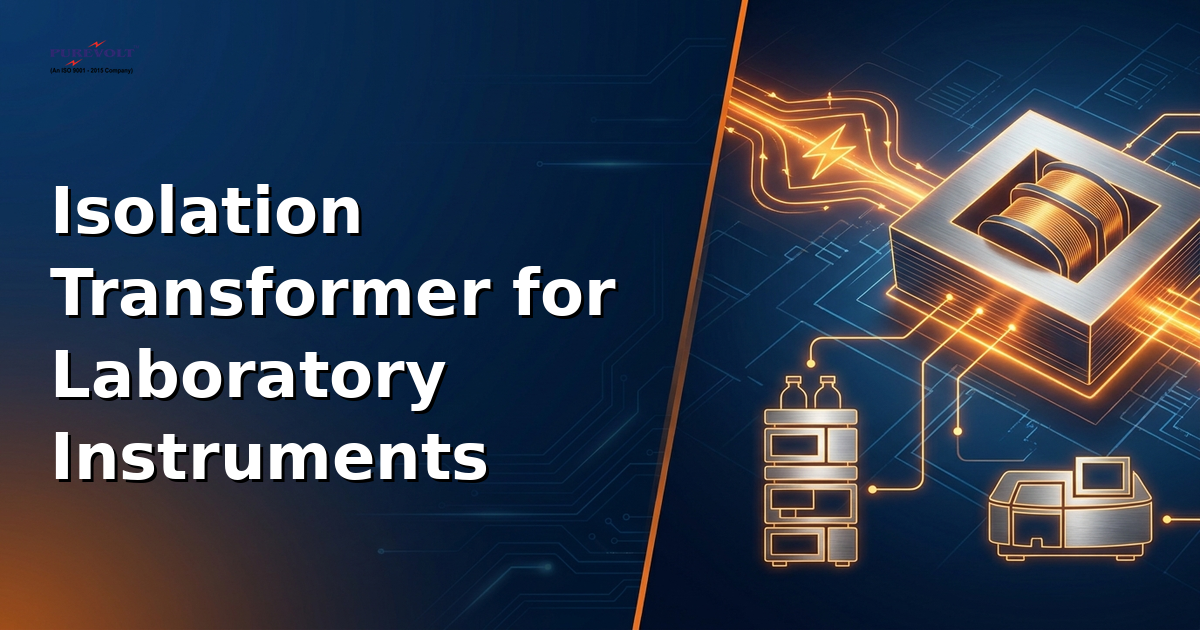
Galvanic isolation means there is no direct electrical connection between the primary and secondary windings. The supply voltage is transferred magnetically. The secondary winding creates a new, independent reference point that is not connected to the building ground — breaking the ground loop path that allows noise to enter the instrument.
The protection mechanisms are three distinct benefits:
Ground loop elimination: When two instruments share a building ground reference and are connected by a signal cable (USB, RS-232, detector cable), any potential difference on the ground creates a circulating current — a ground loop. This current flows through signal cables as interference noise. An isolation transformer assigned to one instrument breaks the shared ground reference and eliminates the loop.
Common-mode noise rejection: Common-mode noise appears equally on both supply conductors relative to ground. An isolation transformer’s internal shield between windings (the Faraday shield in a shielded isolation transformer) intercepts common-mode noise before it reaches the secondary. Well-specified laboratory isolation transformers achieve common-mode rejection ratios (CMRR) of 60–100 dB.
Low leakage current: Laboratory isolation transformers are designed for low earth leakage current — typically below 0.5 mA — which is important both for electrical safety in a laboratory environment and for preventing leakage current from disturbing sensitive electrochemical measurement circuits.
How to Size an Isolation Transformer for Laboratory Instruments?
Size by summing total instrument load and adding 20% margin for startup surge current from motors.
The formula is the same as for any transformer sizing:
Required KVA = Total Instrument Load (kW) ÷ Power Factor (0.8) + 20% Safety Margin
Sizing options for laboratory configurations:
Per-instrument bench isolation (most common for high-sensitivity instruments):
– One 1–3 KVA isolation transformer per HPLC system or spectrophotometer
– Provides maximum isolation — no cross-coupling between instruments
– Recommended for GMP pharmaceutical QC labs and research labs with data integrity requirements
Room-level isolation (for smaller labs with multiple instruments):
– One 5–15 KVA isolation transformer feeding all instruments in a lab room
– More cost-effective for smaller labs with less demanding instruments
– Reduces the number of units requiring maintenance and periodic testing
| Application | Recommended Configuration | KVA Range |
|---|---|---|
| Single HPLC system | Dedicated per-instrument unit | 1–3 KVA |
| Pharmaceutical QC lab (4–6 instruments) | Per-instrument for HPLC/AAS, room-level for others | 1–5 KVA per unit |
| Hospital diagnostic lab | Room-level unit for instrument bench | 5–15 KVA |
| Research laboratory | Per-instrument for high-sensitivity, shared for routine | 1–10 KVA |
For pharmaceutical laboratories, per-instrument isolation is the standard specification because it provides clean, independent power to each validated instrument, making it easier to demonstrate that the power supply does not contribute to measurement uncertainty during instrument qualification.
Isolation Transformer vs Servo Stabilizer: What Does a Laboratory Need?
A laboratory needs both devices: servo stabilizer for voltage regulation and isolation transformer for noise elimination and safety isolation.
A servo stabilizer corrects over-voltage and under-voltage — it keeps the supply within ±1% of nominal. It does not eliminate electrical noise or break ground loops. An isolation transformer provides galvanic isolation, eliminates ground loops, and blocks common-mode noise — but it does not regulate voltage. It will pass voltage fluctuations from the primary side to the secondary side without correction.
For a well-protected laboratory, the correct architecture is:
- Servo stabilizer at the laboratory distribution panel — regulates grid voltage fluctuations to ±1% for the entire lab
- Isolation transformers at individual instrument benches — provides galvanic isolation and noise elimination at point of use
- Online UPS for critical instruments — provides backup power during outages for instruments running long-duration analyses (HPLC overnight runs, stability chamber controls)
Each layer addresses a separate risk. A servo stabilizer alone does not provide isolation. An isolation transformer alone does not protect against voltage sags. Together they provide comprehensive power quality for laboratory instruments.
Purevolt India’s isolation transformer range covers 1 KVA to 1,000 KVA in single-phase and three-phase configurations. Laboratory-grade shielded isolation transformers are available with Faraday shields, low leakage current specification, and NABL-calibrated test reports for instrument qualification documentation. The servo voltage stabilizer range covers the voltage regulation component of the laboratory power protection stack.
Frequently Asked Questions About Isolation Transformers for Laboratories
Laboratory professionals ask these questions when specifying isolation transformers for analytical and QC instruments.
What is the difference between an isolation transformer and a line conditioner for laboratory instruments?
An isolation transformer provides galvanic isolation and ground loop elimination. A line conditioner typically adds voltage regulation, surge suppression, and filtering on top of isolation. For pharmaceutical QC labs where a servo stabilizer is already installed at panel level, a basic isolation transformer per instrument is the correct specification.
Line conditioners are appropriate where a single device needs to provide both voltage regulation and isolation for a critical instrument — for example, an AAS or ICP-OES in a research lab without a central servo stabilizer on the laboratory supply.
How often should an isolation transformer in a laboratory be tested?
Isolation transformers in laboratory environments should be tested annually for insulation resistance (IR) using a 500V megger test, and calibration traceability of the isolation performance should be documented as part of the instrument qualification package.
Pharmaceutical laboratories operating under FDA 21 CFR Part 211 or WHO GMP TRS 961 guidelines should document the isolation transformer as part of the Utilities Qualification for the laboratory, with defined acceptance criteria for insulation resistance and leakage current.
Do isolation transformers reduce measurement noise in laboratory instruments?
Yes. A properly specified isolation transformer with an electrostatic (Faraday) shield achieves common-mode noise rejection of 60–100 dB, directly reducing measurement noise in sensitive instruments like HPLC detectors, UV-Vis spectrophotometers, and electrochemical analysers.
The noise reduction is most significant in environments with strong noise sources nearby — VFD-driven HVAC systems, large motor loads, switching power supplies, or other instruments on the same ground reference. In a quiet laboratory environment with clean power, the benefit is smaller but the isolation protection value for data integrity and safety compliance remains.
What KVA isolation transformer does an HPLC system need?
An HPLC system typically needs a 1–3 KVA isolation transformer, sized for the pump motor (typically 0.3–1 kW), detector, column oven, and controller — total load 0.5–2 kW — with 20% margin for startup surge from the pump motor.
A single 2 KVA shielded isolation transformer covers most HPLC configurations. For HPLC-MS (mass spectrometry) systems that draw higher power, verify the total system load on the instrument specification sheet and size accordingly.
Conclusion
Laboratory instruments need isolation transformers because electrical noise, not just voltage fluctuation, is the primary power quality threat to measurement accuracy and data integrity in analytical and QC laboratories. The protection architecture is specific:
- Servo stabilizer at panel level for voltage regulation across the laboratory
- Isolation transformer at instrument level for galvanic isolation and noise elimination
- Online UPS for critical instruments requiring continuity during outages
For pharmaceutical and research laboratories with GMP or data integrity requirements, per-instrument isolation transformers with Faraday shields and NABL-calibrated test reports are the correct specification. They enable instrument qualification documentation that demonstrates the power supply does not contribute to measurement uncertainty.
Purevolt India manufactures isolation transformers from 1 KVA to 1,000 KVA with shielded and unshielded configurations, low leakage current specifications for laboratory applications, and NABL calibration certificates. Request a laboratory isolation transformer quote with your instrument list and laboratory configuration.