
Table of Contents
Industrial servo voltage stabilizers naturally generate some heat during operation. However, there is a major difference between normal operating warmth and servo stabilizer overheating.
Excessive temperature can accelerate insulation aging, damage electrical connections, affect transformers and control components, cause thermal shutdowns, and eventually lead to unplanned production downtime.
“Studies on overall equipment effectiveness show that manufacturers lose an average of 28% of their total available production time to unexpected downtime and disruptions.” (Smart Connected Worker: Downtime in Manufacturing & Productivity Losses)
If a servo stabilizer is getting unusually hot, the solution is not simply to add another fan. The first step is to determine why excess heat is being generated or why the existing cooling system cannot remove it.
This practical guide explains the warning signs, common causes, and checks industrial users should perform.
Warning Signs of Servo Stabilizer Overheating
- Enclosure becoming unusually hot
- Frequent thermal or overload trips
- Stabilizer shutting down after operating for some time
- Burning or heated-insulation smell
- Discolored cable lugs or terminals
- Cooling fan continuously running or not running at all
- Unusual transformer humming
- Output instability after prolonged operation
- Hot spots around cables, busbars, or contactors
- Oil temperature becoming abnormally high in oil-cooled units
A stabilizer that operates normally when first switched on but trips after an extended period deserves particular attention. That often suggests heat is gradually building inside the equipment.
1. Servo Stabilizer Overload
Overload is one of the first things to check when troubleshooting overheating. When a stabilizer continuously carries more current than it was designed for, electrical losses and internal temperature increase.
This can happen when more machinery has been connected, factory production capacity has expanded, the stabilizer was originally undersized, several machines now run simultaneously, or the actual power factor differs from the original assumption.
Check the stabilizer’s rated KVA against the present connected and operating load. Correcting an overloaded system requires addressing the load or stabilizer capacity—not merely increasing ventilation.
Before treating overheating as only a cooling problem, verify the load using Purevolt’s Servo Stabilizer KVA Calculation Guide.
2. Poor Ventilation Around the Stabilizer
Air-cooled stabilizers require adequate airflow to remove heat. Installing the unit in a cramped room, against a wall, close to other heat-producing machines, or inside a poorly ventilated electrical room can significantly reduce cooling performance.
Never obstruct the ventilation openings provided by the manufacturer.
Check whether
- Air inlets are blocked
- Hot exhaust air can escape
- Objects have been stored around the cabinet
- The equipment room itself is excessively hot
- Multiple heat-producing electrical systems share a small enclosure
3. Cooling Fan Failure
A failed or slow cooling fan is another common cause of servo stabilizer overheating in air-cooled units.
A fan that makes unusual noise or rotates slowly may require attention even if it has not completely stopped. Cooling components should be checked as part of routine preventive maintenance.
Possible fan problems
- Fan motor failure
- Damaged bearings
- Dust-covered blades
- Loose wiring
- Faulty thermostat or controller
- Reduced airflow
- Blocked fan guards
4. High Ambient Temperature
The stabilizer does not operate independently of its environment. If it is installed near furnaces, boilers, compressors, process heating equipment, direct sunlight, or poorly ventilated production areas, the temperature of the incoming cooling air may already be high.
This reduces the ability of an air-cooled system to dissipate internal heat. When selecting equipment for hot industrial environments or continuous heavy-duty operation, cooling configuration should therefore be considered alongside KVA capacity.
5. Dust and Dirt Buildup
Factories can expose electrical equipment to dust, fibers, powder, oil mist, and other contaminants. Over time, dirt can accumulate on cooling fans, ventilation openings, transformer surfaces, busbars, electrical components, and heat-dissipating surfaces.
This can restrict airflow and create thermal insulation around components. Dusty industrial locations may require more frequent inspections than clean electrical rooms.
Cleaning should only be performed with the equipment properly isolated and according to appropriate electrical maintenance procedures.
For India-specific electrical safety requirements, refer to the Central Electricity Authority safety regulations.
6. Loose Electrical Connections
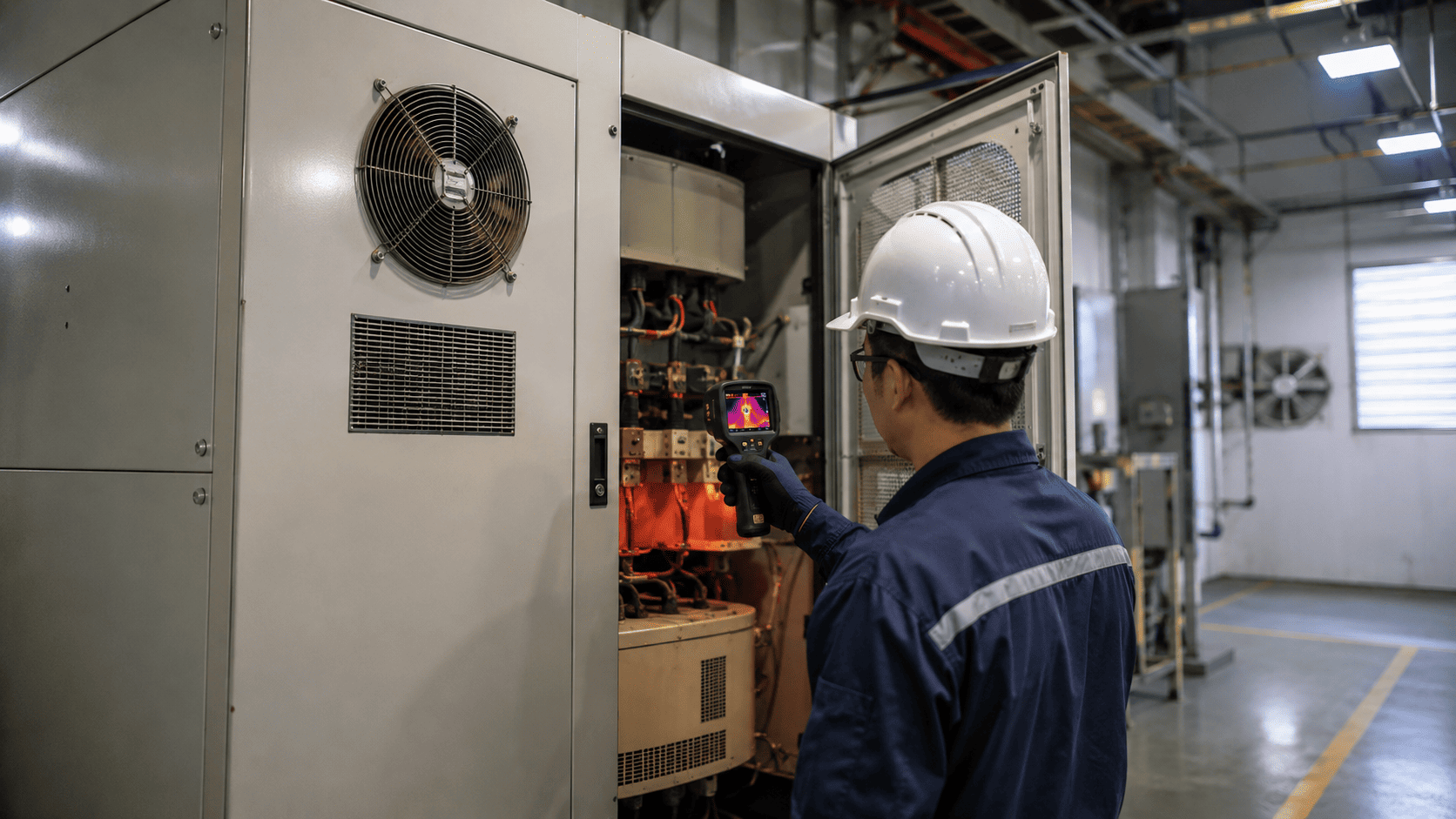
A loose high-current connection creates resistance. Resistance generates heat at the connection point, so one loose cable lug or terminal can create a local hot spot even when the overall stabilizer load appears normal.
Signs may include local discoloration, burn marks, melted insulation, hot cable lugs, or a burning smell. These faults require immediate attention from qualified personnel.
Where a qualified maintenance program uses thermal inspection, Fluke’s guidance on detecting electrical unbalance and overloading with thermal imaging provides useful diagnostic context for identifying abnormal hot spots.
Common locations
- Input cables
- Output cables
- MCCB terminals
- Contactor connections
- Busbars
- Transformer connections
- Neutral terminals
7. Three-Phase Load or Voltage Imbalance
For a three-phase servo stabilizer, abnormal loading on one phase can cause one section of the equipment to operate hotter than the others.
This may result from uneven distribution of single-phase loads, low voltage on one phase, a loose phase connection, a phase-related supply problem, or downstream load imbalance.
The maintenance team should compare voltage and current readings across all three phases. A significant difference should be investigated because current imbalance can increase electrical losses and operating temperature.
“According to standard NEMA motor and power-quality engineering guidelines, as little as a 1% voltage imbalance can cause a 5% to 6% current imbalance, leading to a disproportionate 10°C to 12°C internal temperature rise in connected inductive equipment.” (Voltage Disturbance Engineering: Current and Voltage Unbalance Effects, Maintenance & Engineering: Phase Unbalance and Thermal Risks)
The U.S. Department of Energy’s Eliminate Voltage Unbalance technical tip explains how voltage imbalance increases losses and overheating in three-phase equipment.
8. Continuous Heavy-Duty Operation
Some industrial facilities operate around the clock. A stabilizer supplying CNC machinery, production lines, chillers, compressors, or other continuous loads may spend long periods close to its rated capacity.
If operating duty has changed since the stabilizer was originally purchased—for example, from one shift to three shifts—the installation should be reassessed. The original KVA and cooling arrangement may no longer be ideal.
9. Maintenance Has Been Neglected
Servo stabilizers are industrial electrical systems and require periodic inspection. A lack of maintenance can allow several small issues to combine.
Preventive maintenance helps detect these problems before they develop into thermal trips or major failures.
For a broader industrial context, the U.S. Department of Energy’s Motor Repair Tech Brief identifies overloading, high ambient temperature, low or unbalanced voltage, and inadequate ventilation among common overheating stresses.
- Fan efficiency decreases
- Dust accumulates
- Terminals loosen
- Contact surfaces deteriorate
- Hot spots develop
- Oil condition or level requires attention
- Protection devices go unchecked
Quick Overheating Troubleshooting Table
| Warning Sign | Possible Cause | Recommended Check |
| Entire cabinet unusually hot | Overload or poor ventilation | Check load and airflow. |
| Hot only near one terminal | Loose connection | Technician inspection |
| Fan not operating | Fan/control failure | Inspect the cooling system. |
| Stabilizer overheats during peak production. | Excessive load | Recalculate KVA |
| Overheats only in the afternoon | High ambient temperature | Check room temperature/ventilation. |
| One phase runs hotter. | Phase/load imbalance | Compare phase currents. |
| Unit trips after long operation | Heat accumulation | Load and cooling inspection |
| Heavy dust inside the enclosure | Restricted cooling | Schedule safe cleaning. |
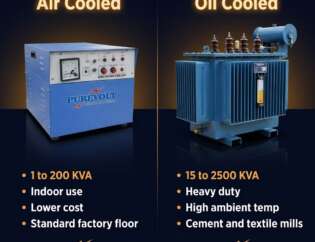
Air-Cooled vs. Oil-Cooled Servo Stabilizers
Cooling methods become particularly important where loads are large, operating hours are long, or environmental temperatures are high.
Air-Cooled Servo Stabilizer
An air-cooled stabilizer relies on natural or forced airflow for heat removal. It is commonly suitable where:
- KVA requirement is moderate
- Installation is indoors
- Ambient temperature is controlled
- Adequate ventilation is available
- Dust levels are manageable
Advantages include relatively simple construction and easy routine inspection. However, cooling performance depends heavily on good airflow and clean ventilation paths.
For construction details and typical use cases, review Purevolt’s Single Phase Air-Cooled Servo Voltage Stabilizer.
Oil-Cooled Servo Stabilizer
An oil-cooled servo stabilizer uses insulating oil to absorb and transfer heat from internal components. It is often considered for:
- Higher industrial loads
- Continuous-duty applications
- Hot environments
- Heavy manufacturing
- Installations where better thermal management is required
Oil cooling provides more effective heat dissipation for demanding applications, although oil level, oil condition, leaks, and general maintenance must also be monitored.
For high-load and high-ambient-temperature applications, see Purevolt’s Oil-Cooled Servo Voltage Stabilizer.
Which Cooling Type Should You Choose?
Do not choose between air-cooled and oil-cooled construction based only on purchase price. Consider:
- Required KVA
- Actual load profile
- Number of operating hours
- Ambient temperature
- Installation location
- Dust and environmental conditions
- Future load expansion
Purevolt offers servo stabilizer configurations for different industrial KVA and operating requirements.
Compare available capacities and configurations in Purevolt’s Servo Voltage Stabilizer range.
What Can the Operator Check?
Without opening energized electrical panels, operators can observe:
- Displayed load/current
- Input and output voltage
- Cooling fan operation
- Ventilation blockage
- Room temperature
- Unusual noise
- Burning smell
- Timing of thermal trips
- Whether overheating coincides with peak load
- Whether new machinery has recently been connected
These observations are valuable when reporting the problem to the maintenance team or manufacturer.
When Should a Technician Inspect the Stabilizer?
- There is a burning smell
- Terminals or cables show discoloration
- The stabilizer repeatedly trips after warming up
- Cooling fans have failed
- One phase shows abnormal current
- Oil leakage is visible
- Output voltage becomes unstable
- Abnormal transformer noise develops
- Overheating continues despite adequate ventilation and normal loading
Never bypass thermal, overload, or other protective devices to prevent shutdown.
Preventive Maintenance Checklist
For industrial installations, periodically check:
- Connected load versus stabilizer rating
- Input/output voltage
- Phase currents
- Cooling fans
- Ventilation openings
- Dust accumulation
- Cable and terminal condition
- Contactors and protection devices
- Signs of localized heating
- Oil condition and leakage where applicable
Maintenance frequency should reflect operating hours, load severity, and environmental conditions.
Is Overheating Actually a KVA Problem?
If an existing stabilizer operated correctly for years but began overheating after machinery was added, cooling may not be the root cause. The stabilizer may simply be carrying more load than its original design capacity.
Before replacing fans or modifying the cooling system, recalculate the present load using the Servo Stabilizer KVA Calculation Guide.
For an example of a high-capacity industrial configuration that lists both cooling options and protection features, review Purevolt’s 1000 KVA Servo Voltage Stabilizer.
If the calculated capacity exceeds the existing stabilizer rating, upgrading to a correctly sized unit is likely to be more effective than repeatedly addressing thermal symptoms.
Final Thoughts
Servo stabilizer overheating should never be ignored, especially in continuous industrial operations.
Overload, blocked ventilation, fan failure, high ambient temperature, dust, loose connections, phase imbalance, and inadequate maintenance are among the most important areas to investigate.
The key is to determine whether the problem comes from excessive heat generation or inadequate heat removal.
For industrial users, correct KVA selection, an appropriate cooling method, and regular preventive maintenance provide the best long-term protection against overheating and unexpected downtime.
If your stabilizer is consistently running hot, Purevolt can help evaluate the connected load, operating environment, voltage range, and cooling requirement to determine whether the existing system is correctly selected for the application.